A desktop app for product managers

Become the PM that agents work for.

Your AI staff for product work. It reads your meetings, inbox and Slack, drafts what you owe, and sends nothing without your yes. Runs on your computer, on the AI plan you already pay for. Reach it from your phone.

14 days free, $0 today. Founding price $9 a month, locked for life, first 100 people.
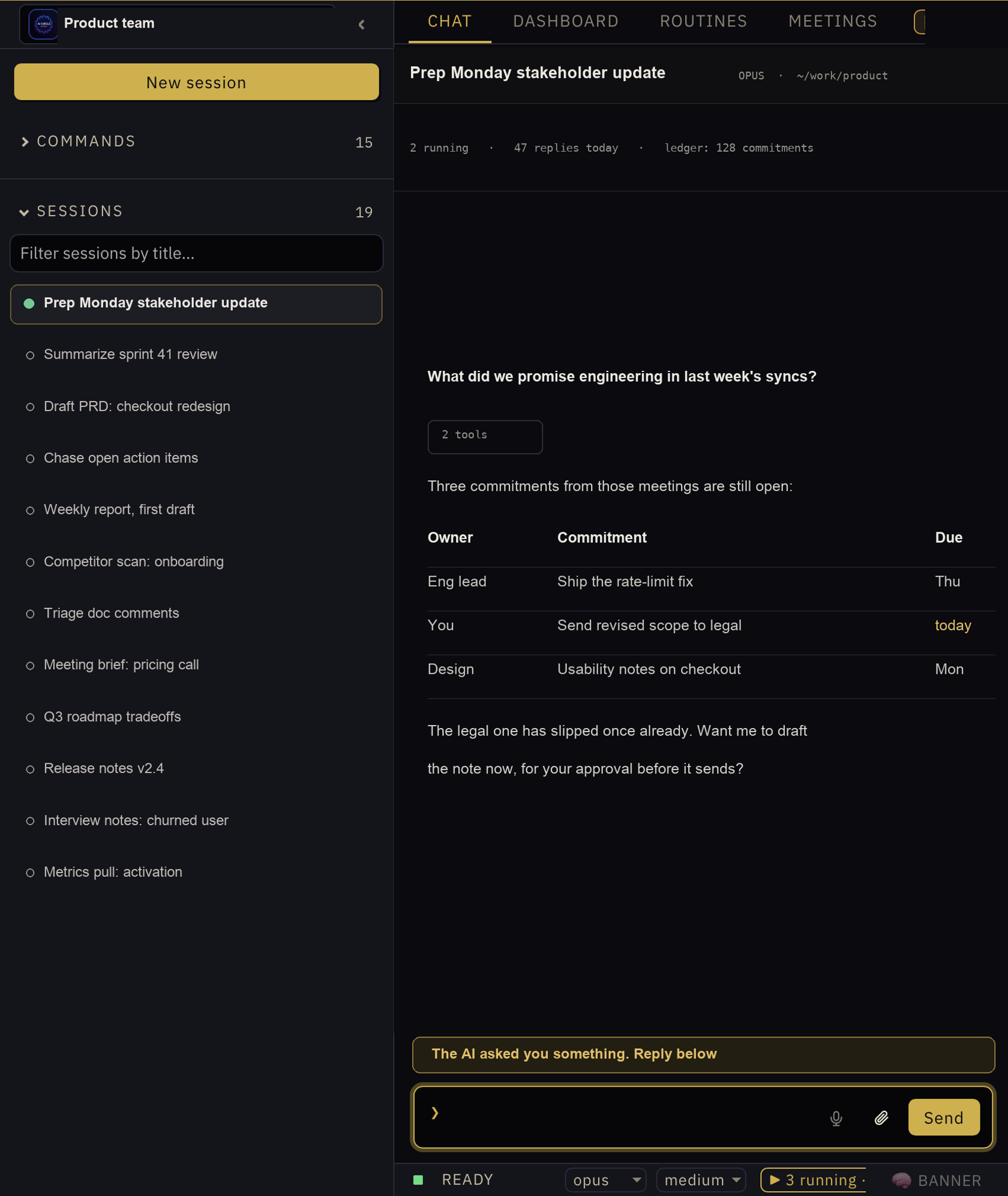
The Agentic PM desktop app: session list on the left, a chat where the assistant lists three open commitments from last week's meetings and offers to draft a follow-up for approval
The actual app. Real screenshot, demo data.Tap the dots

Works alongside your stack.

FaFathomGrGranolaFiFirefliesSlSlackNotionNotionJiraJiraLinearLinearGoogle DocsDocsGoogle DriveDriveGoogle CalendarCalendarGmailGmailConfluenceConfluenceGitHubGitHubFaFathomGrGranolaFiFirefliesSlSlackNotionJiraLinearDocsDriveCalendarGmailConfluenceGitHub

Gmail, Calendar and Drive are built in: Gmail saves drafts only, Calendar and Drive are read-only. Jira, Linear, Notion, Confluence, GitHub and Slack connect through MCP connectors you add yourself. Meeting notes come in from the export of Fathom, Granola or Fireflies. No migration, no new tracker.

The same Monday, twice.

Nothing about your calendar changes. Everything about your morning does.

Without it

09:00. Three transcripts, fourteen doc comments, a status update due at ten.

You start the archaeology. Scrub each recording, remember what was decided, copy the parts that matter, shape a narrative, chase two people who owe you an answer.

By noon you have a summary and no morning left.

09121518

With it

09:00. It already happened while you were asleep.

The update is drafted in your voice. The fourteen comments are triaged into three that need you. The two commitments that slipped last week are on one screen, with who owes what.

09:20 and you are arguing about the roadmap. Which was always the job.

09121518
admin judgment

Illustration of the shape of a day, not a measurement. No time-saving figure is claimed anywhere on this site.

Watch it do the week.

Recorded on a fresh install with sample data. Nothing connected, nothing sent, nothing edited.

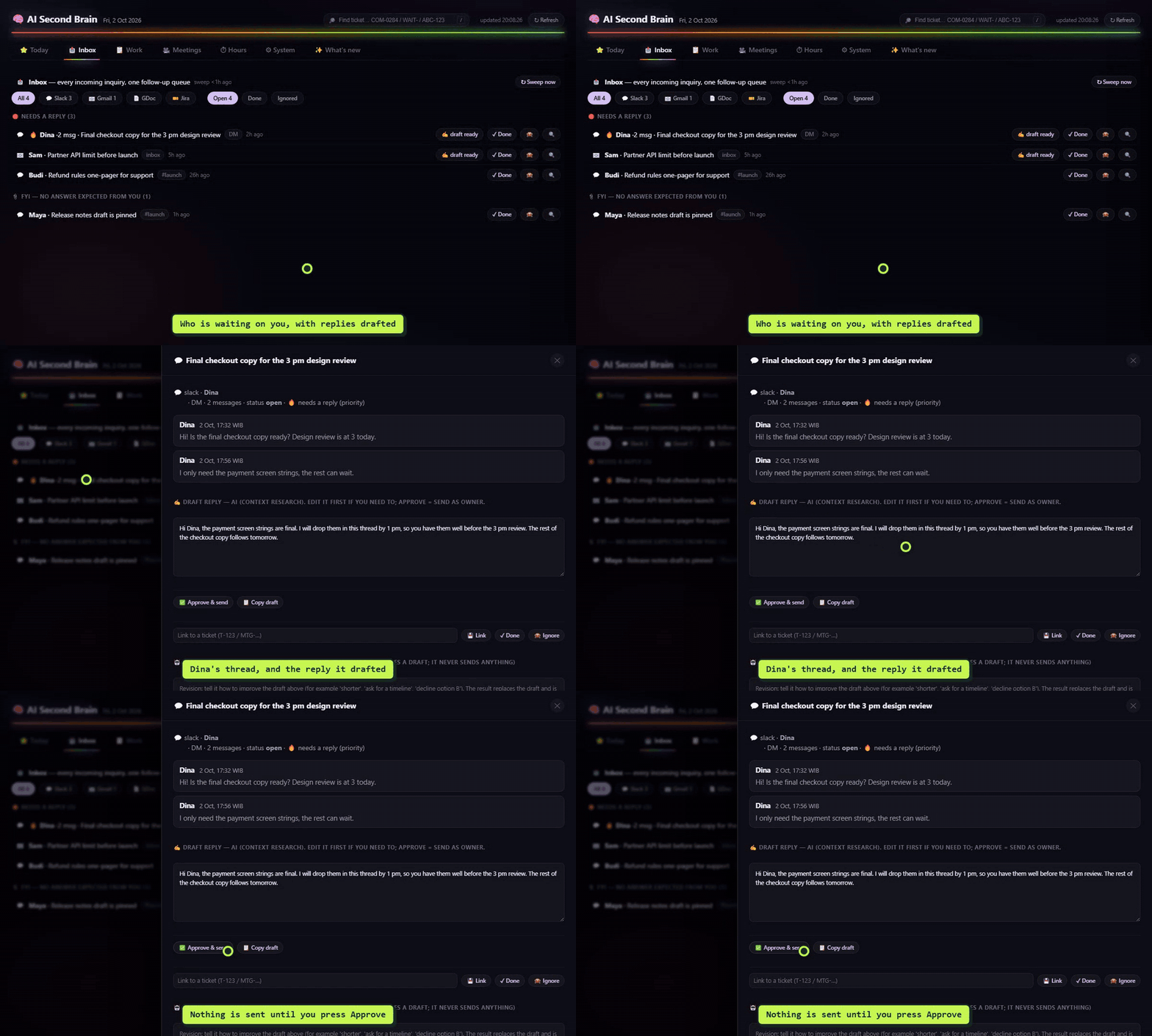
The local inbox: everyone waiting on you in one queue, a reply drafted for each thread, and an Approve button as the only way anything sends
The inbox.Everyone waiting on you lands in one queue, replies already drafted. Nothing goes out until you press Approve.
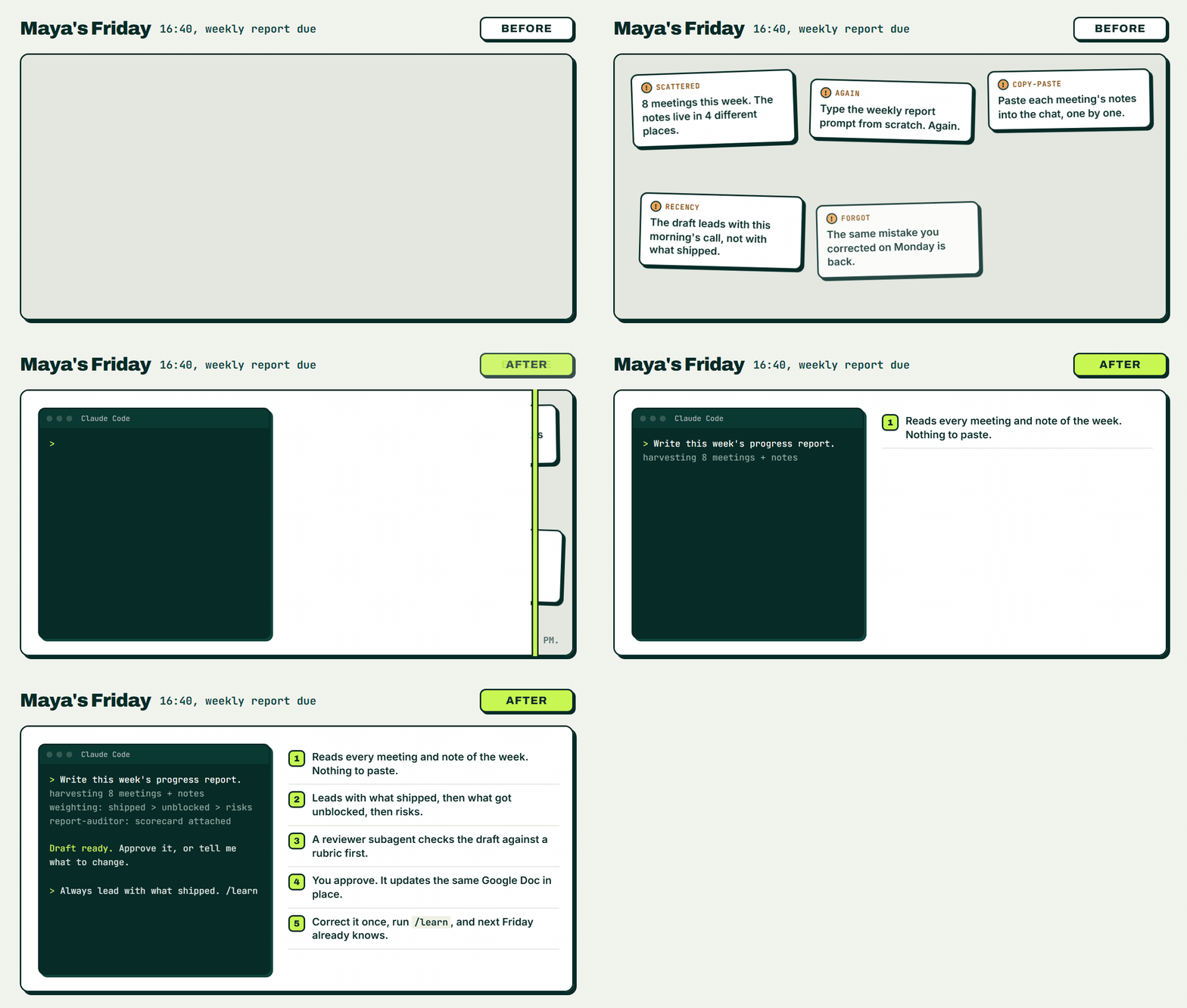
A PM's Friday at 16:40: before, six cards of manual work piling up; after, one prompt and a drafted weekly report with an auditor scorecard
A Friday, before and after.The weekly report that used to eat the afternoon, drafted and checked against your rules before you open it.
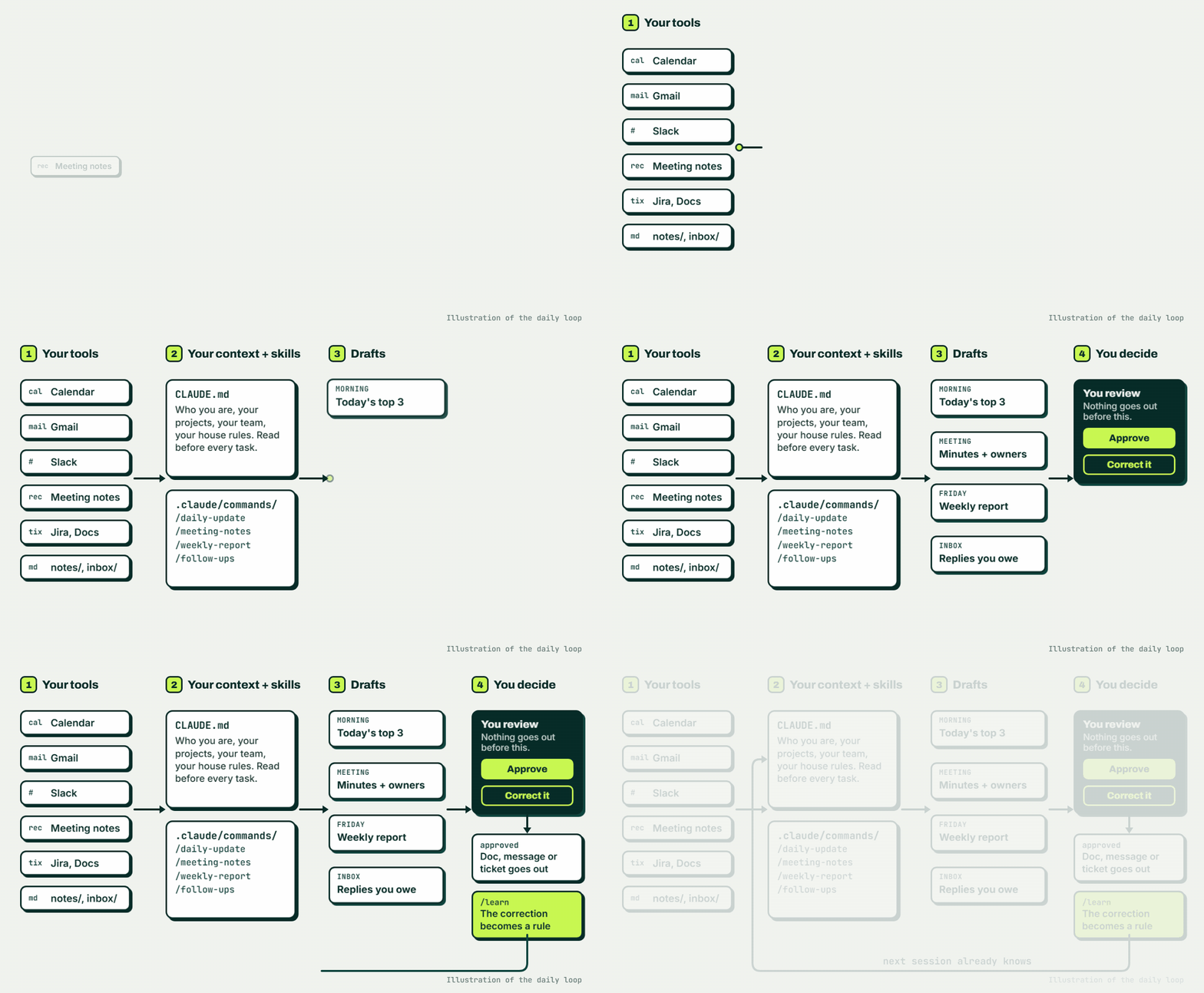
The daily loop: tools and context in, drafts out, you approve or correct, and the correction is remembered by the next session
The loop.Read, draft, wait for your yes. Correct it once and the next session already knows.

Same recordings ship in the README of AI Second Brain, the open-source project the app installs as.

Twelve jobs leave your desk. One stays.

Writing the status updateyouagent
Turning meetings into notesyouagent
Chasing action itemsyouagent
The stakeholder recapyouagent
Triaging doc commentsyouagent
Formatting the docyouagent
Grooming the ticketsyouagent
Drafting release notesyouagent
The competitor scanyouagent
Pulling the metricsyouagent
Follow-up nudgesyouagent
The sprint recapyouagent
The call only you can make still you
0commands shipped
0releases to date
0commitments from 15 real meetings
0had no owner at all

Six moments in a product manager's week.

Not features. The actual moments where the work goes sideways, and what changes in each one.

Monday, 09:00 The stakeholder update is due at ten

What you do now

  • Open eight tabs: three transcripts, two Slack threads, the roadmap doc, the tracker, last week's update.
  • Scrub each recording to remember what was actually decided, not what you hoped.
  • Copy fragments into a scratch doc, then rewrite them into something a VP will read.
  • Realise two items are stale, message two people, wait.

What happens instead

  • The draft is already in the doc when you open the laptop, written in your format and your voice.
  • Every claim in it is traced to the meeting it came from, so you can defend any line.
  • Items that moved since last week are flagged at the top, not buried.
  • You spend the hour deciding what to do about the news, not assembling it.

From archaeology to editing.

Ten minutes before a call You are walking in cold

What you do now

  • Search Slack for the last thread with this person, skim it, half remember.
  • Open the doc, scroll to find where the argument stopped last time.
  • Try to recall what you promised them, and hope they do not open with it.
  • Start the meeting by asking them to recap, which spends five of the thirty minutes.

What happens instead

  • One card, opened before you join: what this room decided last time and why.
  • What is still open, and which side each person took.
  • What you owe them, and what they owe you, with dates.
  • You open with a decision instead of a question.

From recall to reference.

Three weeks later The commitment that went quiet

What you do now

  • Nobody mentions it. Your note taker marked it Pending three times and moved on.
  • You find out at the retro, or worse, when a launch date slips because of it.
  • Reconstructing what happened means reading four transcripts side by side.
  • The owner changed at some point and no one said so out loud.

What happens instead

  • You run /follow-ups and it lists the open loops and promises it finds in your recent meetings and threads.
  • The Work view shows what you owe, what you are waiting on and which decisions are still open.
  • You pick what to chase and it drafts the message. Nothing is sent without your approval.
  • You chase it while it is still cheap to fix.

From post-mortem to prevention.

Spec day Writing the PRD

What you do now

  • Start from a blank page or, worse, last quarter's template with the wrong context.
  • Re-explain your product to the AI every single time, then edit out the generic parts.
  • Chase the actual numbers: current conversion, ticket volume, the constraint engineering raised.
  • Discover in review that you contradicted a decision made two months ago.

What happens instead

  • The draft starts from your product's real context, not a template.
  • Edge cases and acceptance criteria come as a checklist you prune, not invent.
  • Numbers you did not source are flagged before the doc leaves your hands.
  • Contradictions with earlier decisions surface while you are still writing.

From blank page to first review.

Fourteen comments The doc pile-up

What you do now

  • Read all fourteen to find the three that actually block progress.
  • Half are answered elsewhere, but you have to remember where.
  • Reply to each in a slightly different voice, at slightly different depth.
  • Two turn into threads you forget to close.

What happens instead

  • Triaged into what needs your judgment and what is already answered.
  • Replies drafted for the answerable ones, in your voice, waiting for approval.
  • Anything that quietly changes scope is escalated instead of buried.
  • Nothing sends until you say so.

From reading everything to deciding three things.

Friday afternoon The weekly report

What you do now

  • Reconstruct the week from calendar, Slack, tickets and memory.
  • Undercount what you did, because the small unblocking never gets written down.
  • Format the same sections you formatted last week, and the week before.
  • Send it knowing two teams will ask a question the report should have answered.

What happens instead

  • A week of scattered work assembled into the sections your team already expects.
  • Decisions and their reasons included, not just a list of activity.
  • What slipped, who is blocked, and what is at risk, ranked.
  • You review and correct, which takes a fraction of writing.

From reconstruction to review.

No time-saving figure is claimed here or anywhere else on this site. What changes is the shape of the work, not a number we have not measured.

Eight jobs it does. Twenty six commands. One set of rules underneath.

Each job is a command or a feature you run yourself, or a routine you switch on. Routines are off by default and run only while the app is open. Every job reads the same rules, so nothing starts from zero.

Commitment ledger

The Work view lists what you owe, what you are waiting on and the decisions to make. /follow-ups finds open loops and promises in your recent notes and drafts the chase.

Meeting recorder

Records and transcribes on your own computer. No bot joins the call. The minutes are written by the AI provider you picked.

Recap writer

/weekly-reflect sums up your week, and /daily-update gives you the evening recap. The voiceprint skill checks a draft sounds like you.

Chaser

Draft a chase from the Work view or with /follow-ups. Nothing is sent without your approval.

Meeting brief

/meeting-prep gathers your notes and open items into a one-page brief before a call.

Inbox sweep

Reads every tool you connected, threads you posted in included, and returns at most seven things that need you. Every item it filtered out is listed with its reason, never hidden.

Fact gate

A built-in rule makes the assistant read a shared document before it replaces it, so an edit somebody made while you were working does not quietly disappear. The gdoc-surgical skill ships in every workspace.

Context keeper

Your rules live in CLAUDE.md, and /remember saves a preference or a correction. Every chat reads them, so you do not explain yourself twice.

Runs on the AI plan you already pay for.

Most tools charge you again for model access. This one plugs into your existing subscription, and there is a free path if you have none.

Your API keys are stored locally, shown masked, and never leave your machine. The app has no billing relationship with any model provider.

Switch the model per session. When a better one ships next month, you use it the same day. Closed apps run one vendor's model, and you wait for theirs.

Built-in free optionno card, no key, the default
Claude Pro or Maxofficial sign-in, most capable
GLM Coding Planbudget option
Kimisupports image input
Any compatible endpointyour own base URL and key

Built for teams that cannot ship their meetings to a cloud.

Every note taker on the market uploads your calls. If you work in fintech, health, or anywhere in Europe, that is the sentence your security review dies on.

Everything stays on your device

Recordings, transcripts, the commitment ledger, your context file. All of it lives on your laptop, none of it on our servers. We do not have servers that hold your data.

No bot in your meetings

Recording happens locally on your machine. Nothing joins the call, nothing announces itself, and external participants are never processed by a third party bot.

Your keys, your model, your bill

The app drives your own AI subscription. What gets sent to a model is what you choose to send, under keys you hold, on a bill you already control.

Safe to hand real work to.

An assistant you have to double-check is not delegation. These three rules are built into the app, not left to the model's good behaviour.

It works while you are away from your desk. It does not speak for you.

Scheduled runs read, draft and write notes on their own. The moment one tries to send anything to anyone, the app stops it and keeps the draft for you.

It never claims what it did not do

A run missed because the laptop was closed is written down as missed. A backup says what it actually carried. The recorder waits for proof that recording started.

Everything has one home

Every task, promise and action item is filed under one line of your work tree. "What is happening with the pricing launch?" reads what was filed there, not every file that says pricing.

Worth your time? Ten seconds to check.

Built for you if

  • Your week runs on meetings, Slack threads and shared docs, and you owe people minutes, plans, reports and replies.
  • You write the same documents every week: updates, minutes, PRDs, follow-ups.
  • You want the AI working inside your real tools, with you approving every send.
  • You can open a terminal once to install it, then talk in plain language after that.

Not for you if

  • You want an assistant that sends messages on its own. This one stops and waits for your yes.
  • You want hosted software with nothing to install. This is an app on your machine.
  • You need one shared system for a whole team. It is one person's workspace, on one computer.
  • Your week has few meetings and few recurring documents. There is little for it to take off your plate.

Your meetings never leave your machine. Neither should your mornings.

Start free trial

Documents are solved. Follow-through is not.

Plenty of good tools write your PRD. The harder part is keeping track of what everyone promised, and chasing it.

Agentic PMChatPRDmySecond.aiNote takers
Shipped asDesktop app, live todayWeb chatPlugin inside Claude CodeWeb app and meeting bot
Extra subscription requiredNo, bring your ownIts ownClaude Code ProIts own
Records your meetingsYes, on your machineNoNoYes, in the cloud
Writes the PRD and the updateYesYesYesNo
Knows your product without being told againYesSaved knowledgeShared contextNo
Lists your open loops and promises on requestYesNoNoNo
Drafts the chase, you approve itYesNoNoNo
Your transcripts never leave your machineYesCloudLocalCloud
Price14-day trial, then $9/mo founding ($19 list)Free, then $15/mo$39/seat/mo plus Claude CodeVaries

Checked August 2026 against each vendor's public pricing page. Category comparison, not a feature audit. Tell us if something is out of date and it gets corrected.

Lock founding: $9 for life First 100 people. $0 today, first charge on day fifteen.
Pricing

Fourteen days to find out whether your team drops things.

Free trial

$0

14 days · $0 today

  • The whole app, nothing held back
  • Unlimited meetings while it runs
  • Built-in free AI option
  • Everything stored on your device
  • Cancel before day fifteen and pay nothing
Start the trial

Pro · Founding

$9$19

per month, locked for life · first 100 people · yearly $90

  • Everything in the trial, kept
  • All eight jobs, all 26 commands
  • Runs on your own AI subscription
  • Gmail, Calendar and Drive built in, MCP connectors you add
  • Priority support
  • Price never rises for you, ever
Lock founding: $9 for life
BA

Built by Brian Arfi

Two decades shipping product, currently a product director leading four teams at a loyalty platform in the Gulf. Before that, marketplaces and fintech used by hundreds of millions of people across Southeast Asia. He built this because four commitments went quiet in his own team's meetings, and he found them by hand, months too late.

Questions

The ones everyone asks.

Does Agentic PM upload my meetings to the cloud?

Recordings and notes are files on your computer, and no bot joins your calls. What the AI reads, for example a transcript when it writes minutes, goes to the AI provider you picked.

Do I need a separate AI subscription to use it?

No extra one. It runs on the AI plan you already pay for, including Claude Pro or Max, GLM, Kimi, or any Anthropic-compatible endpoint. There is also a built-in free option that needs no card and no API key.

Does it replace my note taker?

It can record locally itself, and it can also read what Fathom, Granola, Otter or Fireflies already export. It is designed to sit on top of whatever you already use rather than replace it.

How does it know what slipped?

It does not watch in the background. The Work view lists what you owe, what you are waiting on and the decisions to make, read from a ledger your chats write. When you run /follow-ups, it reads your recent meetings and threads and lists the open loops and promises it finds, and drafts the chase for your approval.

How is this different from ChatPRD or a note taker?

Document tools write your PRD but treat every session as isolated. Note takers capture meetings but treat every meeting as an island. Agentic PM keeps a commitment ledger across your meetings, and /follow-ups lists the open loops and promises it finds so you can chase them.

Live now. Fourteen days, $0 today.

Twenty six commands, eight jobs and the commitment ledger, running today. Point it at the meetings you already have and run /follow-ups to see what is still open.

  • Founding price locked at $9 a month for life, first 100 people
  • Card at checkout, nothing charged until day fifteen, cancel in one click
  • Installs as AI Second Brain, for Windows and macOS

Not ready to start? Leave your address and we will write when there is something worth reading.

No spam. Your address is not sold or shared.

14 days free · $0 today
Founding $9/mo, locked for life
Start free